


Adult social care has a recruitment problem – or so we're often told. But what if the real problem starts years before a vacancy is advertised?
Across schools and colleges, young people are encouraged to think about the careers and industries they might like to work in. They hear about medicine, nursing, teaching, engineering and the emergency services.
But how visible is adult social care when these conversations are happening?
What nearly 5,000 students taught us
In Surrey, we've been testing a simple idea: workforce development begins long before recruitment. After all, young people cannot choose careers they have never genuinely encountered.
By taking careers education about adult social care into schools and colleges, we've discovered a powerful way of introducing young people to the sector as a skilled, professional career. Over six months, we spoke directly to nearly 5,000 students.
It was wonderful to see students' surprise as they began to understand that social care happens all around them – in their families, social circles and communities – not only in residential care homes.
We asked students to reflect on what it means to live a good life and to be supported to live well, why qualities such as kindness and patience are professional skills, and what a career in care could offer those who are prepared to learn, develop and progress.
Time and again, we noticed a shift in perception: from seeing care as a dead-end job to recognising it as a profession with prospects. A profession where you change lives – something much more meaningful than simply describing it as "a rewarding career".
At the start of a session, students often described care as "looking after old people". By the end, they were asking about mental health services, technology, apprenticeships, specialist roles, leadership opportunities and degree pathways – all things they hadn't previously associated with adult social care.
One finding surprised us: despite demonstrating many of the values the sector looks for – kindness, empathy, resilience and a desire to make a difference – most students knew remarkably little about adult social care as a career. Nearly every school told us it was the first time their students had encountered the sector through careers education. That single observation explains a great deal.
If young people regularly encounter careers in medicine, nursing, teaching and engineering, but rarely hear about adult social care, should we be surprised when they don't consider it? The issue isn't necessarily that they reject social care; it's that many never have the opportunity to see it alongside the other professions they are encouraged to explore.
The sessions also challenged stereotypes. Research suggests that by the age of 15 or 16, many young people have formed demographic and social stereotypes that can persist into adulthood. One common assumption is that carers are usually women. We saw this in action. At one all-boys' school, the careers lead remarked how valuable it was to challenge gender stereotypes before those perceptions became further embedded.
Why timing matters
Good careers education isn't about persuading young people towards a particular profession. It's about ensuring they make informed choices. That becomes impossible if an entire sector is largely absent from the conversation.
Young people begin thinking about their future careers much earlier than we sometimes realise. They start leaning towards some sectors while quietly ruling others out. By the age of 14, many are choosing GCSE or vocational subjects that help shape their future pathways. This is also a period when horizons can narrow if their exposure to different industries is limited.
If we want young people to make genuinely informed choices, they need to encounter a broad range of professional opportunities before those choices become fixed. Adult social care deserves to be part of that conversation, alongside the other professions that already enjoy greater visibility in schools.
Making social care more visible
Adult social care doesn't just have a perception issue. It has a visibility issue.
Young people cannot choose careers they have never heard about or seen represented.
Every provider has something valuable to offer a local school or college: a guest speaker, a workplace visit, work experience, support for a careers event, or simply a story that brings the sector to life. These opportunities don't need to be large-scale to have an impact. Often, a single conversation with someone working in care can challenge assumptions and open up possibilities that young people had never previously considered.
And remember, some of your best ambassadors may be your youngest colleagues. Their stories are relatable, current and authentic, helping students picture themselves following a similar path.
Rethinking the talent pipeline
If we want a stronger workforce tomorrow, we need to start much earlier than today's recruitment campaign.
By the time providers advertise a vacancy, many young people have already formed views about the careers open to them. The challenge isn't simply to recruit more people into adult social care; it's to make sure they encounter it early enough to consider it in the first place.
If the workforce challenge starts earlier than we think, then so must the solution.
Further information
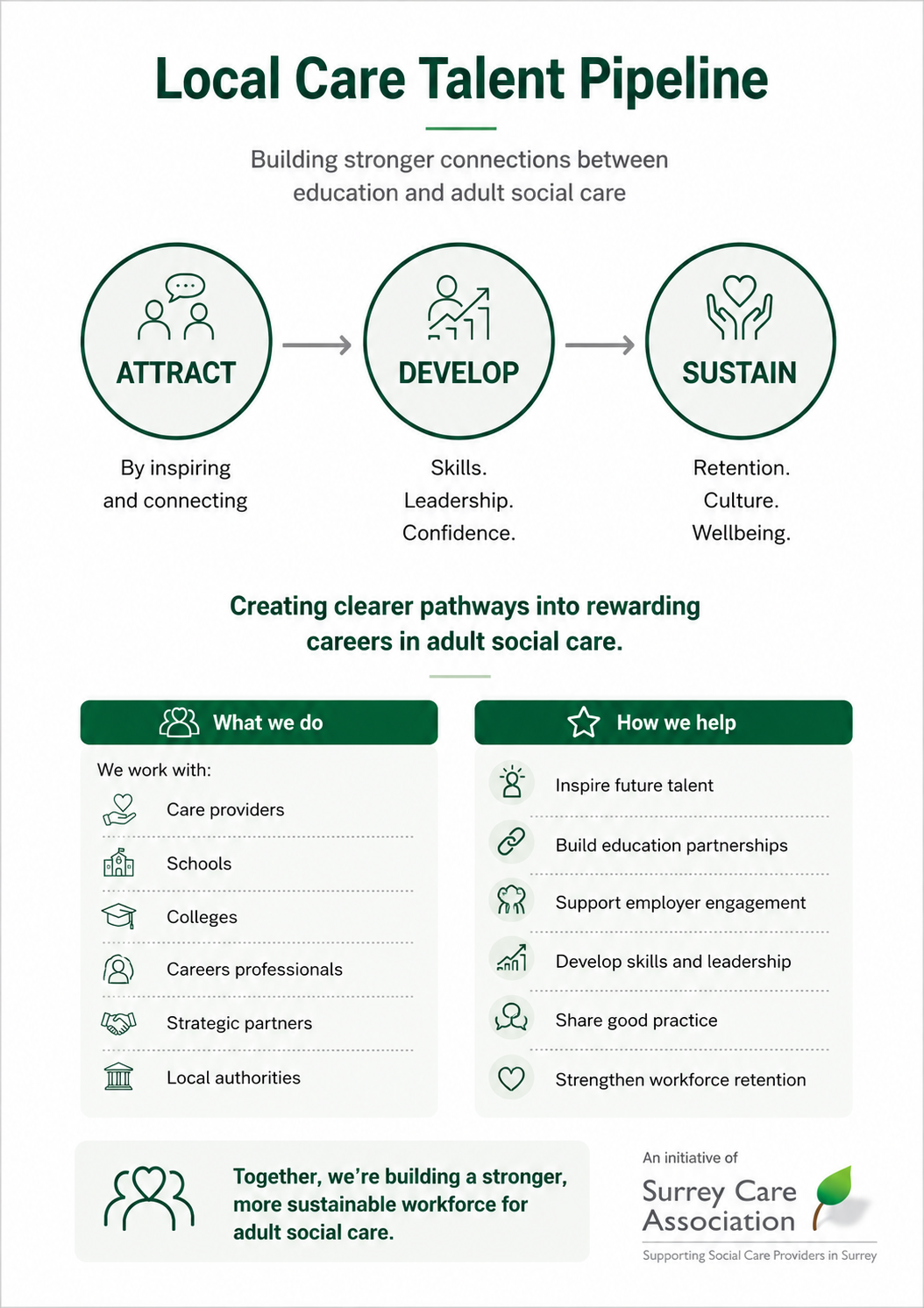
• View the Local Care Talent Pipeline infographic: https://surreycare.org.uk/wp-content/uploads/2026/08/2026-08-03-GC-Infographic-Local-Care-Talent-Pipeline.png
• Find out more about Surrey Care Association's Schools and Colleges Outreach Programme: Schools and Colleges - Surrey Care Association: Advice and Support for Care Providers and Care Seekers