


In care environments, cleaning and disinfection are often treated as the same thing. They're not – and the distinction matters more than most people realise.
Cleaning removes dirt, grease, and organic matter from a surface. It lowers the overall microbial load but doesn't eliminate pathogens. Disinfection is a measured antimicrobial process that reduces microorganisms to a defined, safe level. A surface can look clean – and genuinely feel clean to the touch – while still harbouring harmful bacteria. Conversely, a disinfectant applied to a poorly cleaned surface may fail entirely, because organic matter interferes directly with its chemistry.
Both steps matter. Neither replaces the other.
This isn't just good practice. The CQC's Regulation 15 requires that premises are cleaned or decontaminated in line with current legislation and guidance, and that equipment is cleaned, decontaminated and maintained in line with manufacturers' instructions. In practice, this means the products your team uses – and the order in which they use them – need to be right. Choosing the wrong product, or applying the right product incorrectly, can leave your home exposed during an inspection, and more critically, during an outbreak.
What EN standards actually mean
Products are frequently marketed as "tested to EN1276" or "conforms to EN standards." These phrases don't confirm a product has passed. Understanding what the standard actually requires is the first step to evaluating whether a product is fit for your environment.
EN1276 is the European standard that determines the bactericidal activity of chemical disinfectants and antiseptics, and the test essentially ensures that disinfectants kill bacteria across food, industrial, domestic, and institutional environments. To pass, a general purpose disinfectant must achieve at least a 5-log reduction – eliminating 99.999% of target bacteria – within a specified contact time, at a defined dilution rate and temperature, under controlled laboratory conditions.
That distinction between 99.9% and 99.999% is significant. If a surface is contaminated with 1,000,000 bacteria, a product achieving 99.9% reduction would leave 1,000 surviving organisms. A product achieving the 99.999% standard required by EN1276 would leave only 10. And given that E. coli can double in number every 15 minutes under the right conditions, even that small residual population can grow rapidly. In a care home environment, where residents may be elderly, immunocompromised, or recovering from illness, the margin for error is narrow.
An efficacy claim is only meaningful when it includes the dilution rate, contact time, temperature, and whether testing was conducted under clean or dirty conditions. A product described only as "tested to EN1276" tells you very little without those details.
Contact time – the detail most people overlook
Disinfectants aren't instantaneous. Every product has a contact time – the period during which a surface must remain visibly wet to achieve its tested kill rate. A product may pass EN1276 at a 1% dilution with a five-minute contact time. That same product won't achieve the standard if the surface is wiped dry after 30 seconds.
This has real implications for how your team works day to day. Spraying and immediately wiping may clean a surface. It may not disinfect it – and in high-touch areas, shared bathrooms, or during an outbreak, that gap has direct consequences for resident safety and your compliance position.
It's worth asking: does your current cleaning protocol make contact time achievable in practice? In a room that needs to be turned around quickly, or a communal area with constant foot traffic, there's often pressure to move on before the dwell time has elapsed. Training your team on contact time – and choosing products whose contact times are realistic for your working environment – is as important as choosing the right product in the first place.
Clean conditions vs dirty conditions
Not all EN testing is conducted under the same conditions. Some products are tested under clean conditions – a controlled laboratory environment with minimal organic matter. Others are tested under dirty conditions, with higher levels of organic contamination designed to simulate the realities of a working environment.
A disinfectant solution is not effective if there is visible soiling such as faeces or blood – cleaning is essential before disinfection is carried out. That's the clinical reality underpinning the distinction between these two testing conditions. Products tested under dirty conditions have demonstrated stronger real-world resilience, because they've been evaluated against contamination levels that more closely resemble the environments they'll actually be used in.
In care homes, where body fluids, food residue, and organic matter are unavoidable features of daily life, this is a directly relevant consideration when choosing products – particularly in clinical areas, sluice rooms, and bathrooms.
One-step vs two-step disinfection
Some disinfectants are formulated to clean and disinfect in a single application – no pre-clean required. These one-step products are tested under dirty conditions, with elevated levels of organic contamination built into the protocol. A product that passes under those conditions has demonstrated it can perform where it matters most, without relying on a prior cleaning stage.
Two-step products require a surface to be cleaned first, before disinfection can be effective. Used correctly – and in the right sequence – both approaches can achieve compliant results. But they place different demands on your team and on your training.
The choice between them isn't just a product decision. It's a workflow decision. If your housekeeping team is working under pressure, a one-step product that removes the risk of sequence errors may be safer in practice, even if a two-step approach is theoretically equivalent. If your team is well-trained and working in areas with lower contamination risk, a two-step product may be entirely appropriate. The point is to make the choice deliberately, with the right information – not by default.
What this means for your home
The products your team uses every day have a direct impact on resident wellbeing, your ability to prevent and manage outbreaks, and your readiness for CQC inspection. The CQC expects providers to demonstrate an effective approach to assessing and managing the risk of infection, in line with current relevant national guidance, and to show that premises and equipment are kept clean and hygienic with clear roles and responsibilities in place.
That standard isn't met by having the right products on the shelf. It's met by having the right products, used correctly, by a team that understands why each step matters. The difference between cleaning and disinfection, between a one-step and two-step product, between a 60-second and five-minute contact time – these aren't technical footnotes. They're the details that determine whether your infection control measures actually work.
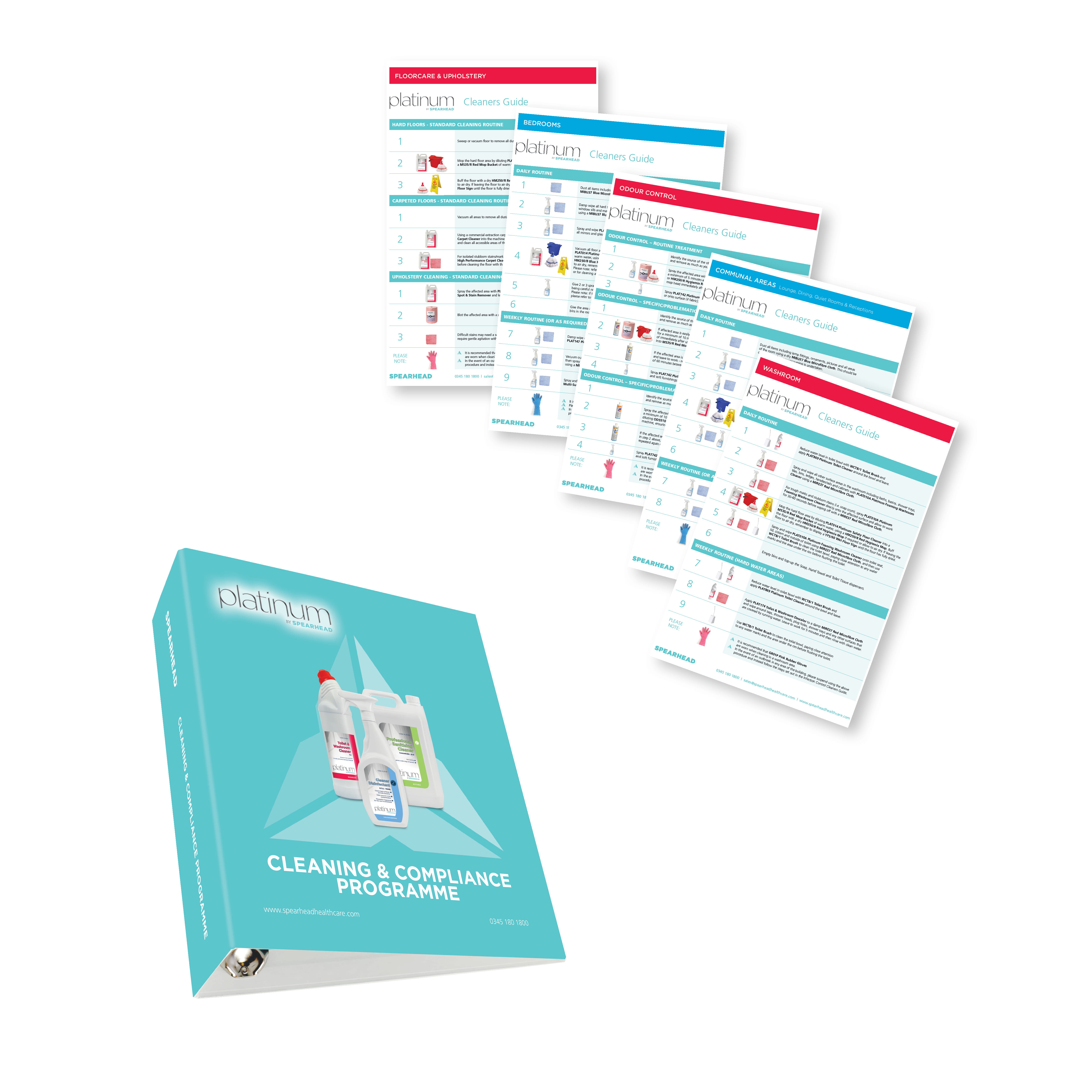
This is where Spearhead can make a real difference. Every care home we work with gets a complete Cleaning & Compliance Programme as standard – the right certified products, professionally installed dosing systems, personalised COSHH documentation, and on-site training delivered by our own experts. It's everything your team needs to clean compliantly and confidently, without the admin burden falling on you. If you'd like to find out more, get in touch and we'll arrange a visit.